



This post may contain affiliate links which means we may receive a commission for purchases made through links. Read more on our Privacy Policy.
Introduction to Solar Inverter Systems
“Microinverter vs String Inverter: Compare performance, cost, and efficiency of each solar inverter to choose the best solution for your home or business.”
Solar energy has become one of the fastest-growing and most efficient renewable energy sources for homes and businesses around the world. At the heart of every solar installation is the inverter, a device that converts the direct current (DC) produced by solar panels into alternating current (AC) electricity that powers your appliances, lighting, and electronics. Choosing the right inverter is critical because it affects the overall performance, efficiency, and reliability of your solar system.
When evaluating inverter options, the microinverters and string inverters debate is one of the most important decisions a homeowner can make. Both types serve the same primary purpose: converting DC to AC. However, they differ in how they operate, their efficiency under different conditions, installation complexity, and long-term performance. Understanding these differences helps you select the most suitable solution for your energy needs, roof layout, and budget.
Table of Contents
An off-grid solar system using a string inverter to efficiently convert DC power from multiple panels into usable AC electricity.

String Inverters Explained
Microinverter vs String Inverter: String Inverter Features & Advantages
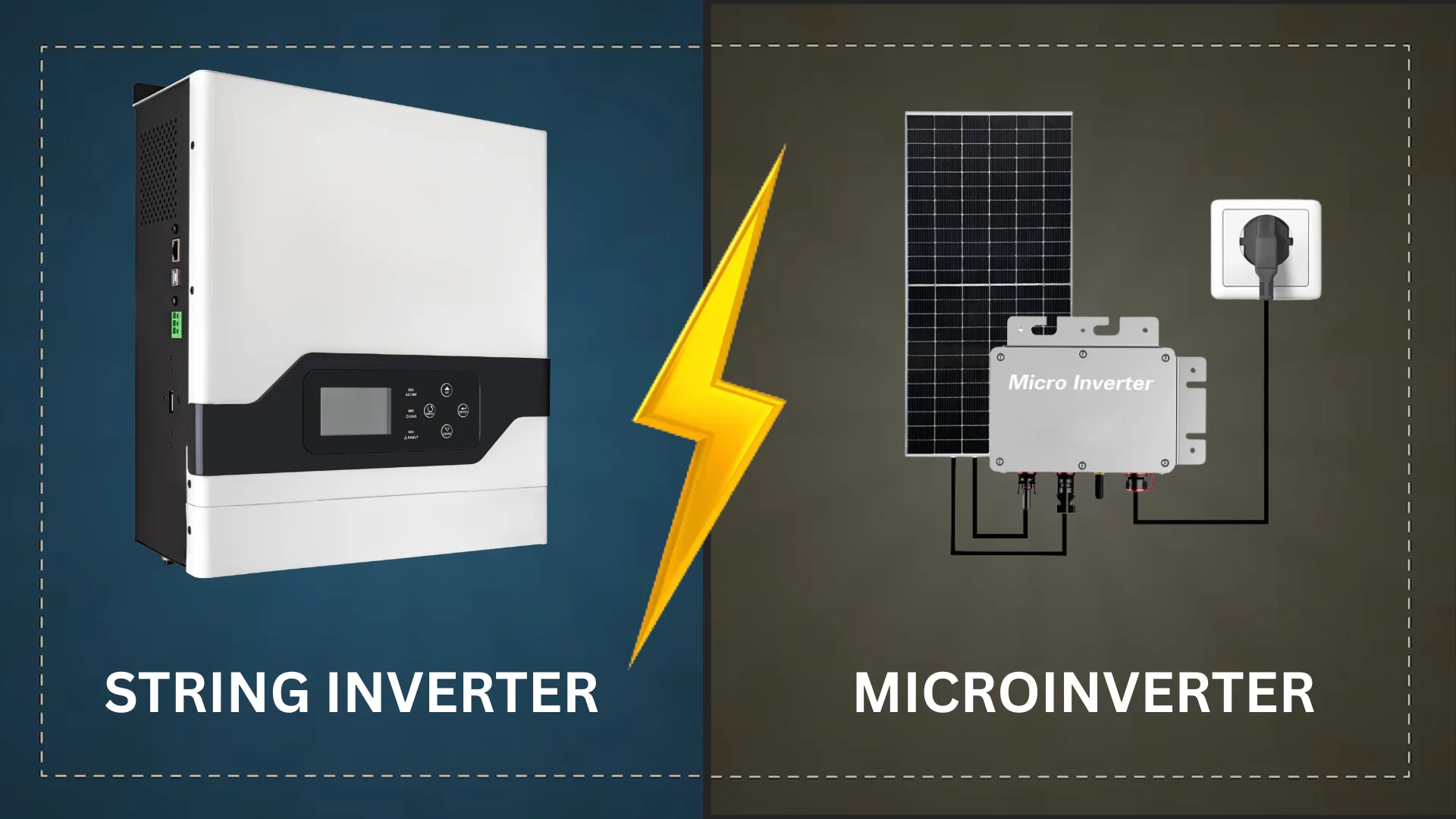
String inverters are the conventional choice in the solar energy industry. In this setup, multiple solar panels are connected in series, forming a “string.” The DC electricity from all panels flows into a central inverter, which converts it into AC electricity for household use.
String inverters are known for their reliability, cost-effectiveness, and simplicity. Here’s a closer look at their advantages:
7 Key Benefits and Features of String Inverters
1. Proven Reliability
String inverters have been widely used in residential and commercial solar systems for decades. In the comparison of Microinverter vs String Inverter, one of the major advantages of string inverters is their proven track record. Many homeowners prefer a tried-and-true solution backed by extensive manufacturer support, spare parts availability, and industry expertise. Reliability is especially important in long-term solar investments, where consistent performance over 20–25 years is expected.
2. Cost-Effectiveness
String inverters are generally more affordable than microinverters because the system uses a single central inverter rather than multiple smaller units. Installation is simpler, which reduces labor costs. For homeowners evaluating string vs micro inverter comparison , the cost difference can be significant, making string inverters attractive for those with budget constraints or larger solar arrays where a centralized solution is more practical.
3. Simplified Maintenance
Maintenance for string inverters is straightforward. The central inverter is often installed in a convenient location, such as a garage, basement, or exterior wall. If the inverter fails, it can be replaced without disturbing the entire solar array on the roof. This simplicity is a key factor when comparing Microinverter vs String Inverter, as it reduces both time and service expenses over the system’s lifetime.
4. Improved Performance with Power Optimizers
Older string inverter systems could lose efficiency due to shading or mismatched panels. Modern string inverters often include power optimizers, allowing each panel to operate more independently. This improvement reduces energy losses from shading, debris, or slight differences in panel output. In the cost-effective vs advanced inverters debate, these enhancements make string inverters more competitive by increasing energy yield while retaining their traditional advantages.
5. Scalability for Future Expansion
String inverters are relatively easy to expand if your energy needs grow. Adding more panels is possible as long as the central inverter has sufficient capacity or additional strings can be created. Homeowners planning gradual system growth often prefer string inverters because they provide a practical and cost-effective way to increase solar production over time.
6. Compatibility and Accessibility
Because string inverters have been used extensively in the solar industry, compatible components, spare parts, and experienced technicians are widely available. This ensures easier maintenance and repairs, which is a significant advantage when comparing Microinverter vs String Inverter systems. The widespread industry adoption guarantees that your system remains serviceable over the long term.
7. Strong Warranty and Support Options
Many string inverter manufacturers offer comprehensive warranties and robust customer support. This provides homeowners confidence that their investment is protected against unexpected failures. In the Microinverter vs String Inverter comparison, strong warranty coverage enhances the value proposition of string inverters, making them a safer, lower-risk option for long-term solar installations.
Because string inverters have been used extensively in the solar industry, compatible components, spare parts, and experienced technicians are widely available. This makes maintenance and repairs easier, which is a significant advantage when evaluating Microinverter vs String Inverter options. The existing infrastructure ensures that your system remains serviceable for decades.

Microinverters Explained
Microinverter vs String Inverter: Benefits of Microinverters
Microinverters represent a decentralized approach to solar power conversion. Instead of one central inverter handling multiple panels, microinverters are installed on each individual solar panel. This setup allows every panel to independently convert DC to AC electricity, offering several distinct advantages over string inverters.
1. Enhanced Performance in Challenging Conditions
A major advantage of microinverters is their ability to maintain optimal performance even when some panels are shaded or partially obstructed. Because each panel operates independently, debris, dirt, or shading on one panel does not reduce the output of others. In the ongoing Microinverter vs String Inverter comparison, this makes microinverters the preferred choice for homes with complex roofs, nearby trees, or varying roof angles.
2. Detailed Monitoring Capabilities
Microinverters provide panel-level monitoring, giving homeowners detailed insights into the performance of each solar panel. This granular data helps detect underperforming panels or inverter issues quickly, allowing for faster corrective action. For those comparing Microinverter vs String Inverter, the ability to monitor performance at the panel level is a major benefit for maximizing energy output and maintaining efficiency.
3. Modular and Flexible Design
Microinverters are modular. Adding additional panels is simple, as each panel operates independently without reconfiguring the existing system. This incremental scalability is a strong advantage over string inverters, making microinverters ideal for homeowners planning gradual solar expansion.
4. Improved Safety
Microinverters reduce high-voltage DC wiring on the roof because each panel converts DC to AC directly. This lowers electrical risks and simplifies compliance with strict safety codes, including rapid shutdown requirements. Safety-conscious homeowners often favor microinverters in the Microinverter vs String Inverter debate.
5. Optimized Energy Harvesting
Microinverters prevent a single underperforming panel from affecting the entire system’s energy output. Each panel contributes its full potential, ensuring maximum energy production even in less-than-ideal conditions.
6. Long-Term Reliability Considerations
While microinverters are durable, they are exposed to environmental conditions like heat, moisture, and temperature fluctuations. More components on the roof means more potential failure points, but many homeowners find the efficiency, monitoring, and performance advantages outweigh this drawback.
7. Higher Upfront Investment
Microinverters require a higher initial investment because each panel needs its own inverter. Installation is also more labor-intensive. However, for homeowners with complex roof layouts, shading issues, or future expansion plans, the benefits often justify the cost.

Comparing Microinverters and String Inverters
Here’s a quick comparison of key factors in the Microinverter vs String Inverter decision:
| Feature | String Inverter | Microinverter |
|---|---|---|
| Initial Cost | Lower | Higher |
| Maintenance | Centralized and simpler | Individual panel maintenance required |
| Performance in Shade | Reduced | Each panel independent |
| Monitoring | System-level | Panel-level |
| Scalability | Moderate | Highly modular |
| Lifespan | Long, proven | Durable, but more components on roof |
| Safety | Standard | Higher (lower DC voltage on roof) |
How to Choose Between Microinverters and String Inverters
Choosing the right inverter depends on several factors:
- Roof Layout: Simple, unshaded roofs work well with string inverters; complex or shaded roofs benefit from microinverters.
- Budget: String inverters are cheaper upfront; microinverters cost more but may yield more energy long-term.
- Monitoring Needs: If you want detailed panel-level insights, microinverters are superior.
- Expansion Plans: Microinverters are easier to scale incrementally.
- Safety Concerns: Microinverters reduce high-voltage DC wiring risks.
Recommendation:
- String Inverters: Best for cost-conscious homeowners with simple roofs.
- Microinverters: Ideal for shaded, multi-angle roofs or those wanting detailed monitoring and expansion flexibility.
FAQs: Microinverter vs String Inverter
Q1: Which inverter lasts longer?
Both types can last 20+ years, but string inverters are simpler to maintain and replace.
Q2: Which inverter gives more energy output?
Microinverters often produce slightly more energy, especially in shaded or complex roof conditions.
Q3: Are microinverters more expensive to repair?
Repairs may require accessing the roof, but they are infrequent, and the increased energy yield often offsets costs.
Q4: Can I mix microinverters and string inverters?
Some hybrid systems exist, but for maximum efficiency, it’s recommended to stick with one type per array.
Final Thoughts
When deciding Microinverter vs String Inverter, both types provide reliable solar solutions. Your choice should consider roof layout, shading, budget, and long-term energy goals. String inverters offer affordability, simplicity, and proven reliability, while microinverters excel in performance optimization, safety, monitoring, and modularity. By understanding these differences, homeowners can confidently select an inverter that maximizes efficiency, energy output, and long-term value.