




This post may contain affiliate links which means we may receive a commission for purchases made through links. Read more on our Privacy Policy.
Discover how off-grid solar panel kits work with 3 essential setups—from basic camping systems to full home power solutions.
Off-grid solar panel kits provide a dependable and efficient way to generate electricity independently—whether for a short camping trip or achieving complete energy self-sufficiency at home. While the technology may initially seem complex, it becomes far more approachable when broken down into practical, real-world system configurations.
In this article, we’ll explore three common off-grid solar panel kit setups, ranging from a basic portable system to a fully integrated home solution. By the end, you’ll have a clear understanding of how each setup works and which option is best suited to your energy needs.
Table of Contents
1. Off-Grid Solar Panel Kits for Beginners (Basic Camping Setup)
Overview
The most straightforward off-grid solar panel kits are designed for small-scale applications such as camping or emergency backup power. These off-grid solar panel kits are capable of powering essential devices like lights, fans, laptops, and small televisions, making them ideal for beginners or portable energy needs.
How the System Works

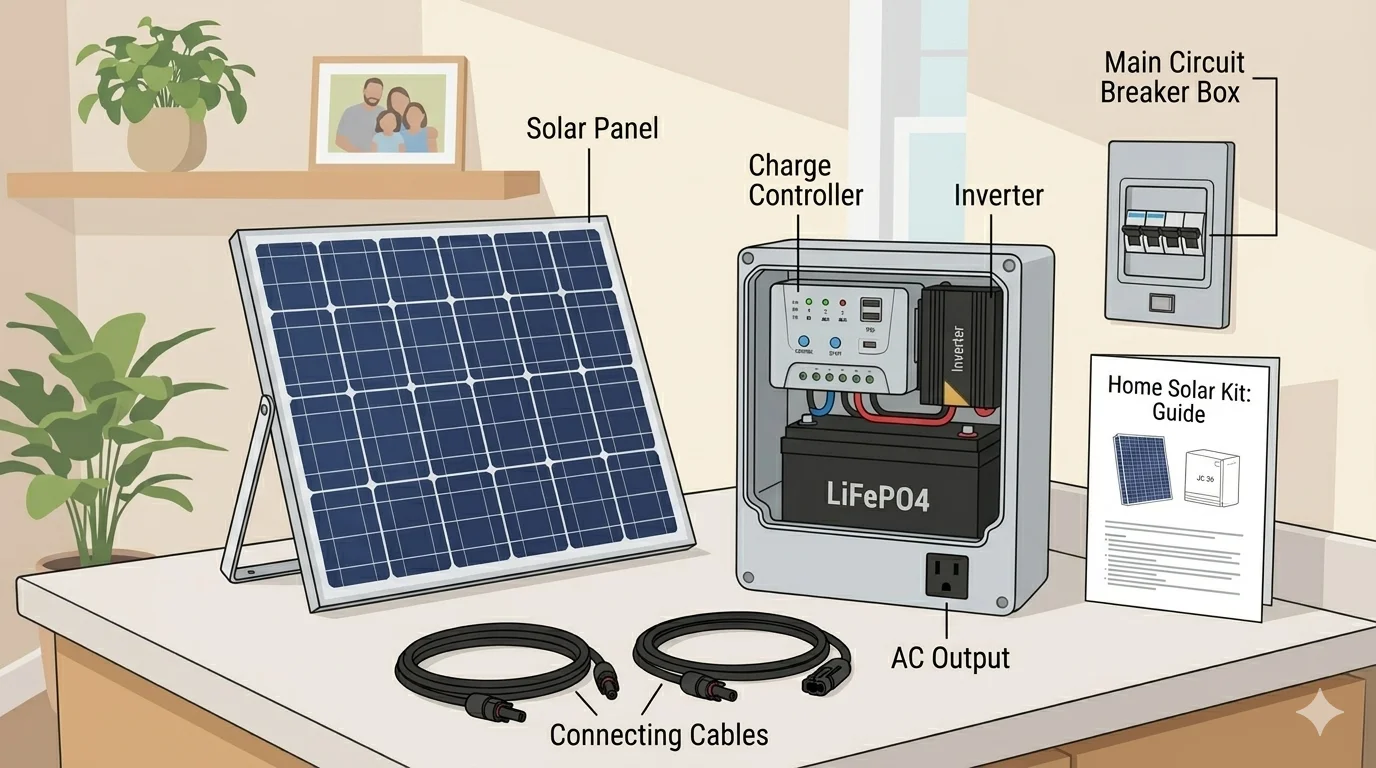
The process in off-grid solar panel kits begins with a solar panel, which captures sunlight and converts it into direct current (DC) electricity. This energy then passes through a circuit breaker, a critical safety component that allows the system to be manually disconnected during maintenance.
Electricity in off-grid solar panel kits is then directed into a charge controller, which regulates the voltage and current flowing into the battery. This prevents overcharging and ensures efficient energy storage. Two types of charge controllers are commonly used:
- PWM (Pulse Width Modulation): Cost-effective and suitable for small systems
- MPPT (Maximum Power Point Tracking): More efficient, especially in varying sunlight conditions
The stored energy in off-grid solar panel kits is held in a lithium iron phosphate (LiFePO4) battery, known for its long lifespan, efficiency, and reliability.
To ensure system safety, fuses are installed along the wiring. These devices protect cables from overheating by interrupting excessive current flow.
Finally, an inverter in off-grid solar panel kits converts the stored DC electricity into alternating current (AC), which is used by most household appliances. In this setup, a 600W inverter with a 1200W surge capacity is typically sufficient for basic power needs.er
How Set Up Works
- Solar Panel: Sunlight is converted into Direct Current (DC) electricity.
- Circuit Breaker: A safety switch used to disconnect power for system maintenance.
- Charge Controller: This regulates power flow and prevents your battery from overcharging (PWM or MPPT types).
- Fuses: Installed along the wiring to protect the system from overheating or excessive current.
- LiFePO4 Battery: Stores energy as DC power for use when the sun isn’t out.
- Inverter: Converts stored DC power into Alternating Current (AC) to power standard household devices like laptops and lights.

2. Mid-Size Off-Grid System with Generator Backup (Best for Cabins)
Overview
For users with higher energy demands, such as those living in off-grid cabins, off-grid solar panel kits offer improved capacity and reliability compared to basic systems. These off-grid solar panel kits are designed to support larger energy loads while maintaining stable and efficient performance. This setup introduces more advanced components and includes a backup power source for added security.
System Configuration

Instead of a single panel, these off-grid solar panel kits use two solar panels connected in series. This configuration increases voltage while maintaining current, which helps reduce power loss over long distances and allows for more efficient wiring.
As with the basic system, a circuit breaker and charge controller are included in off-grid solar panel kits. However, an MPPT charge controller is typically preferred at this level due to its higher efficiency and improved energy harvesting.
The battery system in off-grid solar panel kits is upgraded to a 24V lithium configuration, allowing for greater storage capacity and longer operation. Higher voltage systems also reduce overall costs by minimizing wiring and component requirements.
Additional Components
Inverter Charger
A key upgrade in these off-grid solar panel kits is the inverter charger. This device performs dual functions:
- Converts DC electricity into AC for appliance use
- Charges the battery using an external AC source
Backup Generator
To ensure uninterrupted power, a generator is integrated into these off-grid solar panel kits. It automatically or manually charges the batteries when solar production is insufficient due to poor weather or increased demand.
AC Distribution Panel
An AC distribution panel is included in off-grid solar panel kits to safely distribute electricity to various circuits within the cabin, ensuring organized and protected power delivery.
Cabin System Components

- Dual Panels (Series): Connected to increase voltage, which reduces energy loss over the longer distances found in cabin installations.
- MPPT Charge Controller: High-efficiency tracking that maximizes power harvesting from your panel array to the battery bank.
- 24V Lithium (LiFePO4) Battery: Provides significantly more storage capacity than small portable setups and is more efficient at handling larger appliances.
- Inverter Charger: A dual-purpose unit that converts DC power for your cabin’s AC devices and can also use the generator to charge the batteries.
- Backup Generator: Acts as a safety net, providing power directly or charging batteries during cloudy periods or high-load events.
- AC Distribution Panel: A standard breaker box that organizes and protects the individual electrical circuits throughout your cabin.
3. Large Hybrid Off-Grid System (For Complete Home Energy Independence)
Overview
For full off-grid living, a large hybrid system provides the capacity and reliability needed to power an entire home. This setup is designed for long-term energy independence and maximum efficiency.
Solar Array Configuration

The diagram above illustrates the Large Hybrid Off-Grid System for complete home independence.
Key Features of the Large Hybrid Setup
- High-Voltage Solar Array: Multiple panels are wired in series to create powerful arrays (e.g., 2 strings of 8 panels), maximizing energy harvest for a full household.
- All-in-One Hybrid Inverter: This central hub simplifies the system by integrating the MPPT charge controller, inverter, and battery charger into a single unit.
- Server Rack Battery Storage: Uses high-capacity Lithium (LiFePO4) units, typically providing 20kWh+ of storage to offer “days of autonomy” during cloudy weather.
- System Protection: Includes integrated high-voltage circuit breakers and fuses to handle the significant power flow of a whole-home system.
- Full Distribution: Connects to a standard home AC Distribution Panel to power heavy loads like refrigerators, well pumps, and HVAC systems.
This system typically includes multiple solar panels arranged in series to form high-voltage arrays. For example, two arrays of eight panels each can generate substantial energy to meet household demands.
Hybrid Inverter System
At the center of this configuration is a hybrid inverter, also known as an all-in-one system. This device integrates three essential components:
- Charge controller
- Inverter
- Battery charger
By combining these functions, the system reduces wiring complexity and simplifies installation. Many hybrid inverters also include built-in safety protections such as fuses and circuit breakers.
Battery Storage and Autonomy
Energy storage is handled by multiple lithium batteries, often configured as server rack units. A system with approximately 20 kWh of storage can power a home for two to three days without sunlight.
This reserve capacity is referred to as days of autonomy, an important factor in ensuring reliability during extended periods of low solar production.
Backup and Distribution
A backup generator remains part of the system, providing additional security when solar output is insufficient. Meanwhile, an AC distribution panel manages and distributes electricity throughout the home efficiently.
Advantages and Considerations
Hybrid systems offer streamlined installation and integrated protection features. However, they tend to have higher idle power consumption, which should be considered during system design and load calculations.

System Breakdown
- High-Voltage Solar Arrays: Multiple solar panels are arranged on the rooftop to harvest maximum energy, even in low-light conditions.
- Central Hybrid Hub: A sleek, wall-mounted All-in-One Hybrid Inverter serves as the system’s brain, managing power between the solar panels, batteries, and the home’s appliances.
- 20kWh Server Rack Storage: A high-capacity Lithium (LiFePO4) battery bank provides “days of autonomy,” ensuring the home remains powered for 2–3 days without sunlight.
- Integrated Backup: A Backup Generator is seamlessly connected to the system, automatically triggering to recharge the batteries if they fall below a certain level.
- Smart Distribution: Power flows through a standard AC Distribution Panel, protecting and organizing the electricity used for lights, kitchen appliances, and climate control.
4. Core Components of an Off-Grid Solar System
Essential Elements
Each component plays a critical role in ensuring the system operates safely and efficiently.

Estimated Price Ranges (2026)
Costs vary depending on whether you are building a small camping setup or a full-home system.
| Component | Small Setup (12V) | Mid-Size/Cabin (24V) | Large Home (48V) |
|---|---|---|---|
| Solar Panels | $100 – $250 | $500 – $1,200 | $2,500 – $5,000+ |
| Charge Controller | $20 – $100 (PWM) | $150 – $400 (MPPT) | $600 – $1,500+ |
| Battery Storage | $150 – $400 | $1,000 – $2,500 | $5,000 – $12,000+ |
| Inverter | $50 – $150 | $300 – $800 | $1,500 – $3,500+ |
| Safety (Fuses/Breakers) | $20 – $50 | $100 – $250 | $400 – $800+ |
| TOTAL ESTIMATE | $340 – $950 | $2,050 – $5,150 | $10,000 – $23,000+ |
5. Conclusion: Choosing the Right Off-Grid Solar Setup
All off-grid solar systems operate on the same fundamental principle: generate, store, and use electricity. The primary difference lies in scale, complexity, and reliability.
A basic system is sufficient for light, portable use, while a mid-size setup adds reliability through generator integration. For complete independence, a large hybrid system provides the capacity to power an entire home.
Careful planning is essential when designing any off-grid system. Properly sizing your wiring, selecting the right components, and calculating your energy needs will ensure a system that is both efficient and safe.
By understanding these three setups, you are better equipped to make informed decisions and build a solar solution that meets your specific energy requirements.